
Day 1 – Gingee Fort (Senji Fort)
Date: 13-Aug-16
As planned, our much-awaited Kanyakumari trip began at 3:30 AM on 13 August 2016. The four of us left Bengaluru in the early hours of the morning and headed towards our first destination, Gingee Fort.
Our route took us through Hosur > Krishnagiri > Thiruvannamalai > Gingee. About 1.5 km after Krishnagiri, we took a left towards the Chennai Highway and continued on the service road for about a kilometre before turning right towards Thiruvannamalai via NH77.

Once we took this deviation, the road condition deteriorated significantly. Driving on such rough roads in the dark was not particularly pleasant. The poor stretch continued almost all the way to Thiruvannamalai, where we arrived at around 8:00 AM. We stopped for breakfast at A2B (Adyar Ananda Bhavan) and enjoyed a satisfying meal. What stood out even more was the hospitality of the staff member who served us. Despite the language barrier, he went out of his way to help us, making the experience memorable.
Although the famous Arunachaleswarar Temple at Thiruvannamalai is one of South India’s major pilgrimage destinations, we had to skip it due to our packed schedule. After breakfast, we continued towards Gingee Fort, located about 40 km away.
About Gingee fort
Gingee Fort is located in the Villupuram district of Tamil Nadu. The Maratha emperor Chhatrapati Shivaji famously described it as the “most impregnable fortress in India,” while the British referred to it as the “Troy of the East.”

Despite its fascinating history and remarkable architecture, Gingee Fort remains relatively unknown compared to many other historic forts in India. Our first glimpse of the fort from the road immediately made us understand why it earned such prestigious titles. Built atop a massive and steep hill, the fort itself appears almost impossible to construct, let alone conquer. Yet, throughout history, several dynasties succeeded in capturing it.
The main fort stands atop Rajagiri Hill, which rises to about 800 feet. The vast fort complex includes several notable structures such as Kalyana Mahal, the Elephant Tank, granaries, a gymnasium, Kali Amman Temple, Anjaneya Temple, and Venkata Ramana Swamy Temple.
Exploring Gingee fort
We reached the fort around 9:30 AM. Since the gates had just opened, there were very few visitors, allowing us to explore the complex peacefully.
- Visiting hours: 9 AM to 5 PM
- Ticket issuance: 9 AM to 4.30 PM. Mountain climbing after 3 PM is restricted.
- Entry fee: 15 Rs for Indians, 200 Rs for foreigners.
Kalyana Mahal and the fort complex
One of the most impressive structures inside the fort complex is the seven-storeyed Kalyana Mahal. Built in the Indo-Islamic architectural style commonly seen in the monuments of Bijapur, it stands as a remarkable example of historical craftsmanship. Unfortunately, the structure was locked during our visit, and we could only admire it from the outside.

Near Kalyana Mahal lies a large courtyard and the impressive elephant tank known as Anaikulam. While exploring the complex, we also came across ancient granaries and a historic gymnasium.
The main fort on Rajagiri Hill can be reached via a steep climb consisting of numerous stone steps. Since the trek requires considerable time and effort, we decided to skip the ascent during this visit. However, from our research, we learned that the fort contains watchtowers, narrow gateways, sharp turns, and several defensive features that once made it extremely difficult for invaders to penetrate. Even without climbing to the summit, the fort left a strong impression on us and we decided that we would return someday to explore it more thoroughly.
Venkata Ramana Swamy Temple
Before leaving Gingee, we visited the Venkata Ramana Swamy Temple, located near the Pondicherry Gate within the fort complex. Built by the Nayaks during the 17th century, this temple is considered one of the most significant Vishnu temples in Gingee. Its beautifully carved gopuram and intricately decorated pillared mandapas showcase the artistic excellence of the period.
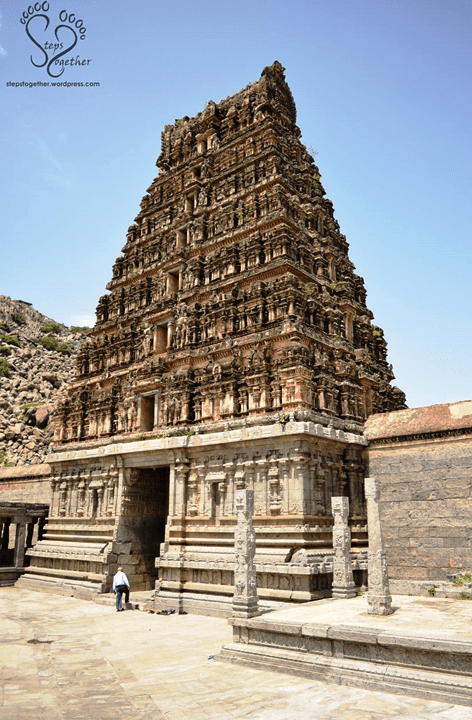
Historical accounts suggest that during their occupation, the French removed several pillars from this temple and transported them to Pondicherry. Interestingly, eight of these pillars can still be seen today at the Gandhi Mandapam near Rock Beach in Pondicherry. The temple premises were calm and serene. During our visit, a small group was singing devotional bhajans, adding a spiritual charm to the atmosphere and making the experience even more memorable.
A brief look at Krishnagiri Fort
While leaving the fort complex, we caught a glimpse of Krishnagiri Fort, which stands atop a 500-foot hill to the north of Rajagiri Hill. Although we did not explore it in detail, its commanding position and imposing appearance further highlighted the strategic brilliance of the entire Gingee Fort complex.

Interesting facts about Gingee fort
Some fascinating facts about Gingee Fort (reference: Wikipedia):
- Gingee is not a single fort but a complex formed by three hills: Krishnagiri in the north, Rajagiri in the west, and Chandrayandurg in the southeast.
- The fort walls extend for approximately 13 km, enclosing an area of about 11 square kilometres.
- The fort stands at a height of around 800 feet and is protected by an 80-foot-wide moat.
- The summit was naturally isolated by a deep chasm measuring about 9.1 metres wide and 18 metres deep.
- Entry into the fort originally required crossing this chasm using a wooden drawbridge.
Timeline of Gingee fort
- 9th century AD: A small fort was constructed by the Chola dynasty.
- 13th century: The fort was modified by the Kurumbars.
- 15th–16th century: The Nayaks, initially lieutenants of the Vijayanagara Empire and later independent rulers, controlled Gingee for nearly 200 years.
- 1677 AD: The fort came under Maratha rule led by Chhatrapati Shivaji.
- 1691 AD: Chhatrapati Rajaram, Shivaji’s second son, escaped to Gingee and continued resisting the Mughals from here. Despite laying siege for seven years, the Mughals struggled to capture the fort.
- 1698 AD: The fort finally fell and later came under the Carnatic Nawabs.
- 1750 AD: The French occupied the fort.
- 1761 AD: The British took control of Gingee Fort.
Admiring the ingenuity, engineering skills, and strategic brilliance of earlier generations, we bid farewell to Gingee Fort and continued our journey towards Pondicherry.
Travel snapshot
- Route Traveled: BTM Layout > Krishnagiri > Chengam > Thiruvannamalai > Gingee Fort
- Distance: 236 km
- Photos: Gingee Fort Album
See also:
- A Mega Nano Trip to Kanyakumari
- Day 1 – Pondicherry (Puducherry)
- Day 2 – Gangaikonda Cholapuram and Darasuram Temples
- Day 2 – Brihadeeswarar Temple, Thanjavur
- Day 3 – Rameshwaram
- Day 3 – Dhanushkodi
- Day 4 – Kanyakumari
- Day 5 – Madurai
The marriage hall looks stunning!
Yeah.. Kalyana Mahal was very attractive.. it must be equally beautiful inside as well, but we couldn’t go inside as it was locked..