Nagarahole
Date: 12-Jun-16
A spontaneous plan often leads to some of the most memorable experiences. During a visit to Mysore, my sister-in-law’s family suggested a drive to Nagarahole National Park. Since the park was not very far from their home, we quickly got ready and set out for a day amidst forests, wildlife, and a lesser-known Tibetan monastery.

About the National Park
Nagarahole National Park is spread across the Kodagu and Mysore districts of Karnataka. The name is derived from the Kannada words naga (snake) and hole (stream or river). Covering an area of approximately 643 square kilometers, the park is one of the most important wildlife reserves in southern India and is also known as Rajiv Gandhi National Park.
The park is home to a wide variety of wildlife, including tigers, elephants, Indian bison (gaur), deer, and many other species.
Safari timings and the drive through the forest
According to information available on the Nagarahole website at the time of our visit, safari timings were:
- Morning: 6:30 AM to 8:30 AM
- Afternoon: 3:30 PM to 5:30 PM
We opted for the afternoon safari and left home at around 12:30 PM. The park was only about an hour away from my sister-in-law’s residence. We travelled via Hunsur and reached the forest entrance area around 1:30 PM. The moment we entered the forest, a beautiful drive awaited us. A narrow, well-maintained road cut through dense greenery, creating an unforgettable experience. As we drove deeper into the forest, we eagerly looked for wildlife. Initially, there were no sightings, but after a few kilometers, we spotted several deer grazing fearlessly along the roadside.
The excitement was visible on everyone’s faces, especially little Avyukth and Ayush, who were thrilled to see the animals up close. As we continued, we came across many more deer peacefully feeding in their natural habitat.

Nagarahole Jungle Safari
At around 2 PM, we reached the safari starting point inside the forest. The safari is organized by the Karnataka Forest Department.
- Mini-bus safari: ₹300 per person for Indians and ₹1,100 for foreigners
- Jeep safari: Available at a higher cost
It is also worth noting that safari operations may be cancelled due to bad weather, vehicle unavailability, or other operational reasons Although the official afternoon safari was scheduled to begin at 3:30 PM, tickets were being issued from 2 PM when we arrived. With fewer visitors at that hour, we quickly purchased our tickets and boarded the mini-bus.
Once the vehicle was full, the safari began. The mini-bus travelled through rough forest tracks surrounded by dense vegetation. Every passenger eagerly scanned the forest for wildlife. Unfortunately, apart from a few langurs, we did not spot any major animals during the one-hour safari. The experience was enjoyable, but we were disappointed not to see any of the larger wildlife species. Perhaps the afternoon timing kept most animals hidden from view.
After the safari ended, we spent some time near the ticket counter enjoying the pleasant weather and taking photographs. Soon, a light drizzle began, and we decided to start our return journey.

The return drive turned out to be even more exciting than the safari itself. As rain began to fall, the forest looked even more beautiful. A few kilometers into the drive, we spotted a group of Indian bison grazing along the roadside. We had never seen these magnificent animals from such close proximity before. There were around 10-15 bison in the herd, making the sight even more impressive.
The disappointment of not spotting wildlife during the safari disappeared instantly. A little further ahead, we encountered another wonderful surprise. An elephant was walking along the roadside with its two calves. Since the animals were near a forest department residence, we chose not to stop and continued our journey.
Tip: There are no good restaurants after crossing Hunsur, so it is advisable to plan your meals accordingly.
The hidden treasure near Nagarahole
One of the most surprising discoveries of the day was a beautiful Tibetan monastery located near Nagarahole. We first noticed a signboard pointing towards the monastery while driving to the national park in the morning. Since we had some time available on our return journey, we decided to visit it.
After exiting the Nagarahole National Park area, we drove about 2-3 kilometers and took a right turn towards Kurubarahosahalli. From there, the monastery was approximately 5 kilometers away. Although the road was narrow, it was well maintained. The entire stretch was dominated by Tibetan settlements. We noticed Tibetan residents throughout the route and followed Google Maps to reach the monastery.
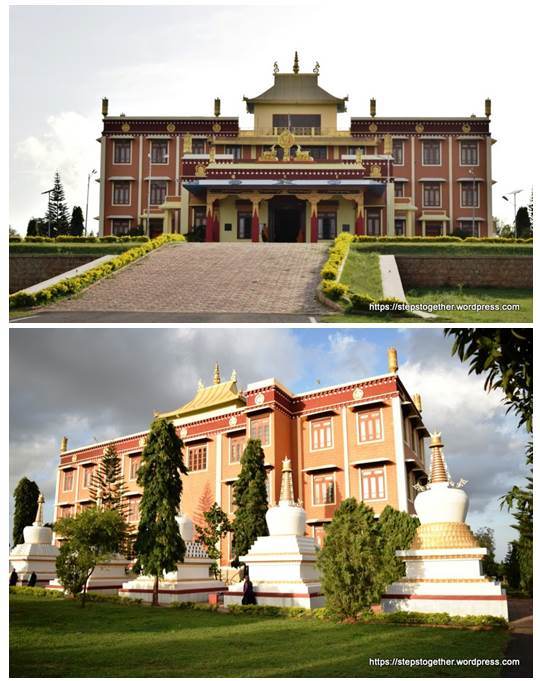
Tibetan Palace (Dzongkar Choede Monastery)
The monastery complex, also known as Dzongkar Choede Monastery, was exceptionally clean, peaceful, and well maintained. Since the place is not widely known among tourists, there were very few visitors. Apart from us, the campus was occupied mainly by Buddhist monks and members of the Tibetan community.
Several student hostel buildings surrounded the monastery complex. When we arrived, prayer sessions were underway. Many monks had gathered inside the main hall, and the entrance had been closed during the prayers. As a result, we could not enter the palace itself. However, simply observing the surroundings was a rewarding experience. Tibetan children played happily around the campus while elderly devotees offered prayers. The atmosphere felt completely different from the places we had visited earlier in the day and gave us a glimpse into a unique culture far from our own.
After spending some time exploring the peaceful campus, we started our return journey at around 6 PM and reached home by approximately 7:30 PM.
Travel snapshot
What began as an unplanned drive turned into one of those journeys that stay with you long after the day ends. The quiet forest roads of Nagarahole, the thrill of unexpected wildlife sightings, and the calm, spiritual atmosphere of the Tibetan monastery came together to create a truly special experience. It was a day that reminded us that the best travel memories are often found in the simplest moments. We returned home with full hearts, carrying memories of nature, peace, and togetherness.
- Route Travelled: Vijayanagar (Mysore) > Hunsur > Nagarahole > Tibetan Palace (Dzongkar Choede Monastery) > Vijayanagar (Mysore).
- Total Distance (To & Fro): 135 km
Nice to know about the Tibetan Palace (Dzongkar Choede Monastery); will try to visit next time.
Thank you for reading.
Hey, liked the detailed writing, something your blog always has. Best time to visit I guess is either during monsoon or winter, is it ?
Thanks for visiting Steps Together.. yeah.. you are right.. forest looks refreshing during monsoon or winter..
Detailed post and lovely shots.Haven’t heard about this monastery.Thanks a lot for sharing.:)
Cheers,
Sriram & Krithiga
Thanks a lot..
Nice and informative post! Thanks for sharing about the place! Would love to visit it sometime ! 🙂
Thanks for reading..
Sounds like a nice serene place, the Monastery looks quite decent in size.
Yes Alok. Very pleasant place. 🙂
i have been to Nagarhole so many times. so was reading the post without envy until i reached the Tibetan palace description. Now now I have never been there because never heard about it till today. So envy your way 🙂
Have noted the monastery details down on my mobile … will not miss it next time
Thanks for reading.. we also noticed the Tibetan palace sign board by chance.. I am sure you will have a peaceful time there ..
Nagarhole seems a great place. You have aroused my curiosity. Already planning my next trip to Karnataka.
Thank you.. glad that you liked our post..
Nagarhole is just too beautiful! I have passed through the forest so many times.
enchanting nagarahole,you have spotted a herd of bison !!. for me only lonely bison and elephant
🙂 Yes. We were lucky to see so many bisons on that day.